

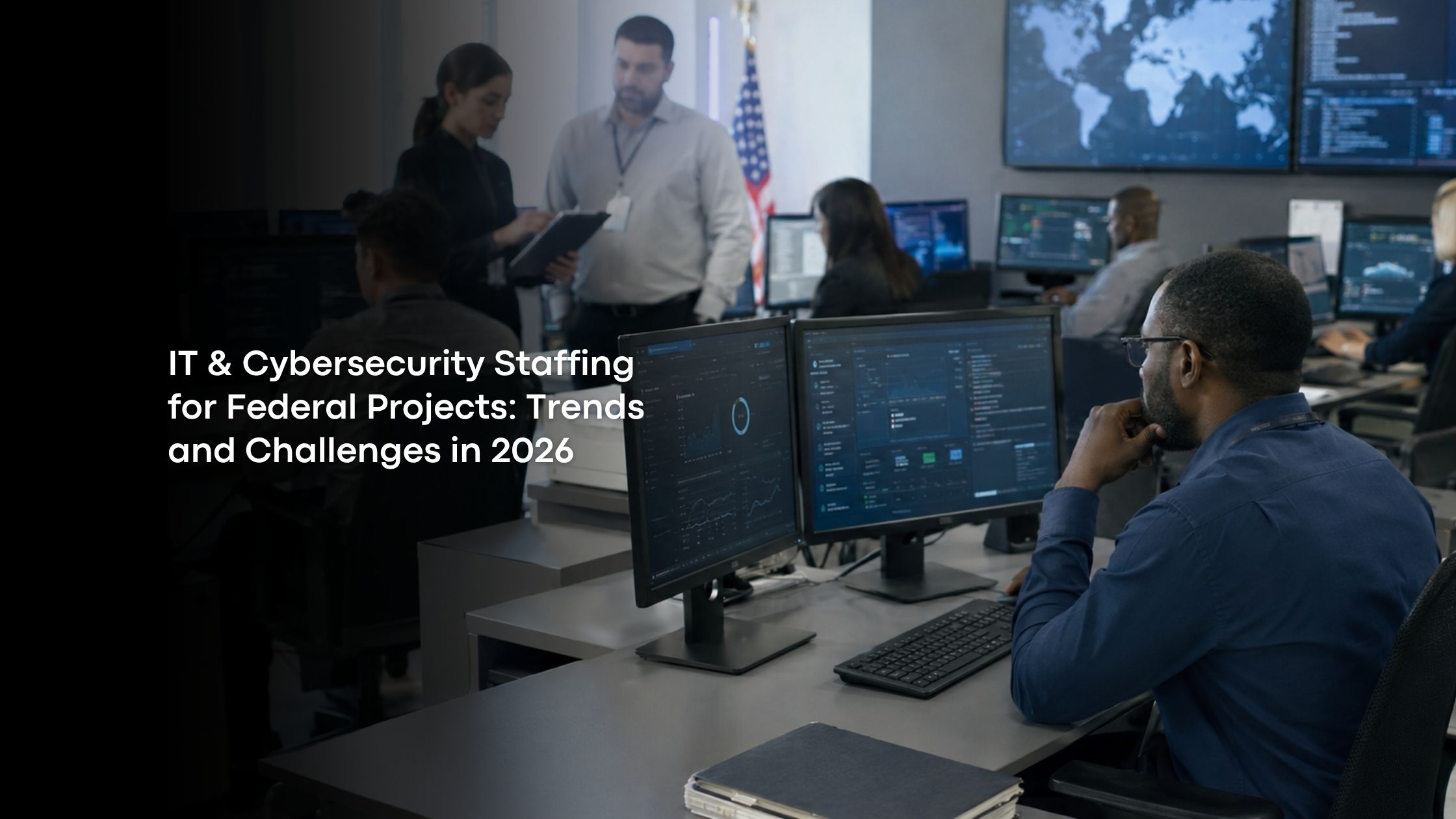
IT and cybersecurity staffing for federal projects in 2026 is under intense pressure. This is because agencies and contractors try to deliver complex digital modernisation programs.
They plan to do it with a workforce that is stretched thin, highly specialized, and often misaligned with emerging mission needs.
As federal agencies ramp up modernization and digital transformation efforts, the role of federal IT staffing has become central to program success and mission resilience.
The combination of rising cyber threats, ambitious federal modernization roadmaps, and a persistent talent gap has turned staffing into both a strategic enabler and a key risk factor for program success. Read below to learn about IT and cybersecurity staffing for federal projects.
Shifting Skill Demands In Federal IT
Federal IT staffing in 2026 no longer centres only on generic help desk or network roles. Agencies are prioritizing cloud‑native architects, data engineers, platform engineers, and integration specialists.
They expect them to operate modern, distributed environments at scale. At the same time, AI‑related capabilities, such as prompt engineering, model governance, and AI‑driven security analytics, are becoming embedded in many federal contracts.
This forces vendors to either upskill current staff or bring in niche expertise.
Roles in Cybersecurity
Cybersecurity roles are evolving quickly as well. Beyond traditional security analysts and incident responders, there is a growing demand for threat‑hunting specialists.
Firms also want security‑enabled DevOps (DevSecOps) engineers, identity‑and‑access‑management experts, and cloud‑security architects.
These professionals must understand both federal compliance frameworks and the operational realities of modern cloud platforms. This creates options for staffing far more complex than normal filling “security analyst” positions.
Many contractors currently evaluate federal IT staffing as a strategic capability rather than a transactional hiring function. They even adjust their resourcing models to work well with shifting government priorities.
Persistent Talent Shortages And Pipeline Gaps
Even if there is high demand, federal IT and cybersecurity staffing faces a structural shortfall. Many cleared pros and experts are concentrated in a few defence and official security hubs.
This creates land-based bottlenecks for federal initiatives spread across the nation. The prolonged time required to secure clearances compounds the problem. This happens because newly trained or junior talent cannot immediately contribute to sensitive programs.
Federal projects cannot withstand evolving threats without a steady influx of high-calibre cybersecurity talent capable of operating in complex, regulated environments.
Entry-level Jobs
Moreover, the pipeline of entry‑level candidates is uneven. Many federal projects require both technical depth and bureaucratic literacy. Yet, early‑career professionals often lack exposure to federal acquisition processes, reporting structures, and compliance postures.
This creates a “double gap” where organizations struggle to hire people who are both technically credible and capable of operating inside the federal ecosystem. This forces them to rely on overstretched senior staff or expensive contract labour.
Burnout, Retention, And Workforce Culture
The federal cybersecurity workforce is under pressure not just from workload but from the emotional toll of constant alertness and regulatory scrutiny. Senior security leaders describe environments where burnout is common and turnover is a major concern.
This is particularly among those who feel disconnected from mission impact or who see limited opportunities for advancement.
In several agencies, repeated budget and staffing constraints have eroded morale and trust in leadership. It made it harder to attract and retain mid‑level and senior technical talent.
Access to cleared IT professionals is a critical differentiator for government contractors competing for sensitive, security‑focused programs and classified workloads.
The Rise Of Internal Upskilling And Hybrid Teams
In light of the talent crunch, many federal agencies and contractors are shifting from pure external hiring to aggressive internal upskilling strategies. Veteran IT staff are now exposed to cloud‑native architectures, zero‑trust security models, and AI‑driven monitoring tools.
This promotes them to support multiple federal projects without leaning on a constant influx of new hires. This trend is especially seen in departments that manage large, multi‑year modernization programs. Here, continuity of expertise is critical for long‑term success.
Hybrid Staffing
Hybrid staffing models are now turning heads. These fuse permanent federal employees, cleared government contractors, and specialized vendor partners into one operational crew.
Such arrangements allow agencies to access cutting‑edge skills without fully owning the long‑term cost of niche expertise. However, they introduce coordination challenges. This is because different employment models, reporting structures, and security postures are present. They all must be managed within a shared mission framework.
Delays, cost overruns, and security gaps in federal programs are increasingly traced back to weak federal IT staffing pipelines and mismatched skill sets on project teams.
Compliance, Risk, And Staffing Decisions
Federal IT and cybersecurity staffing is increasingly treated as a compliance and risk‑management issue, not just a personnel concern.
New directives and oversight mechanisms are pushing agencies to treat staffing capacity as a measurable component of their cybersecurity posture.
Here, project managers are asked to account not only for deliverables but also for the availability of skilled personnel. When staffing proves insufficient, agencies are forced to either delay milestones, scale back scope, or accept higher cyber risk.
Complexity
This dynamic is particularly acute in programs that rely on emerging technologies or cross‑cutting architectures.
For example, zero‑trust rollouts, AI‑integrated platforms, and multi‑cloud environments all require specialized knowledge that is not evenly distributed across the federal workforce.
As a result, staffing decisions can directly determine whether a project meets its security and performance objectives or instead becomes a compliance risk by default.
As the government-contracting landscape grows, organizations are rethinking GovCon IT hiring to prioritize speed, compliance, and mission alignment over generic recruitment tactics.
The Long‑Term Outlook For Federal Staffing
Looking beyond 2026, IT and cybersecurity staffing for federal projects will likely remain a central strategic challenge. The number of federal-focused programs involving cloud, AI, zero trust, and data‑driven decision‑making is expected to grow.
This will further strain an already tight talent pool. At the same time, workforce‑centric policies, such as skills‑based hiring, expanded use of apprenticeships, and targeted investments in upskilling, are beginning to reshape how agencies approach talent acquisition.
Final Thoughts
In the long term, sustainable federal IT staffing frameworks will be the deciding factor in whether agencies can deliver secure, agile, and mission‑ready technology outcomes.
Partner with GovCon Associates to tap into their specialized recruiting and staffing solutions built for the government‑contracting community.
Amplify your federal staffing strategy by leveraging GovCon Associates’ deep experience in cleared, mission‑critical placements across contracts, IT, engineering, and compliance roles.