

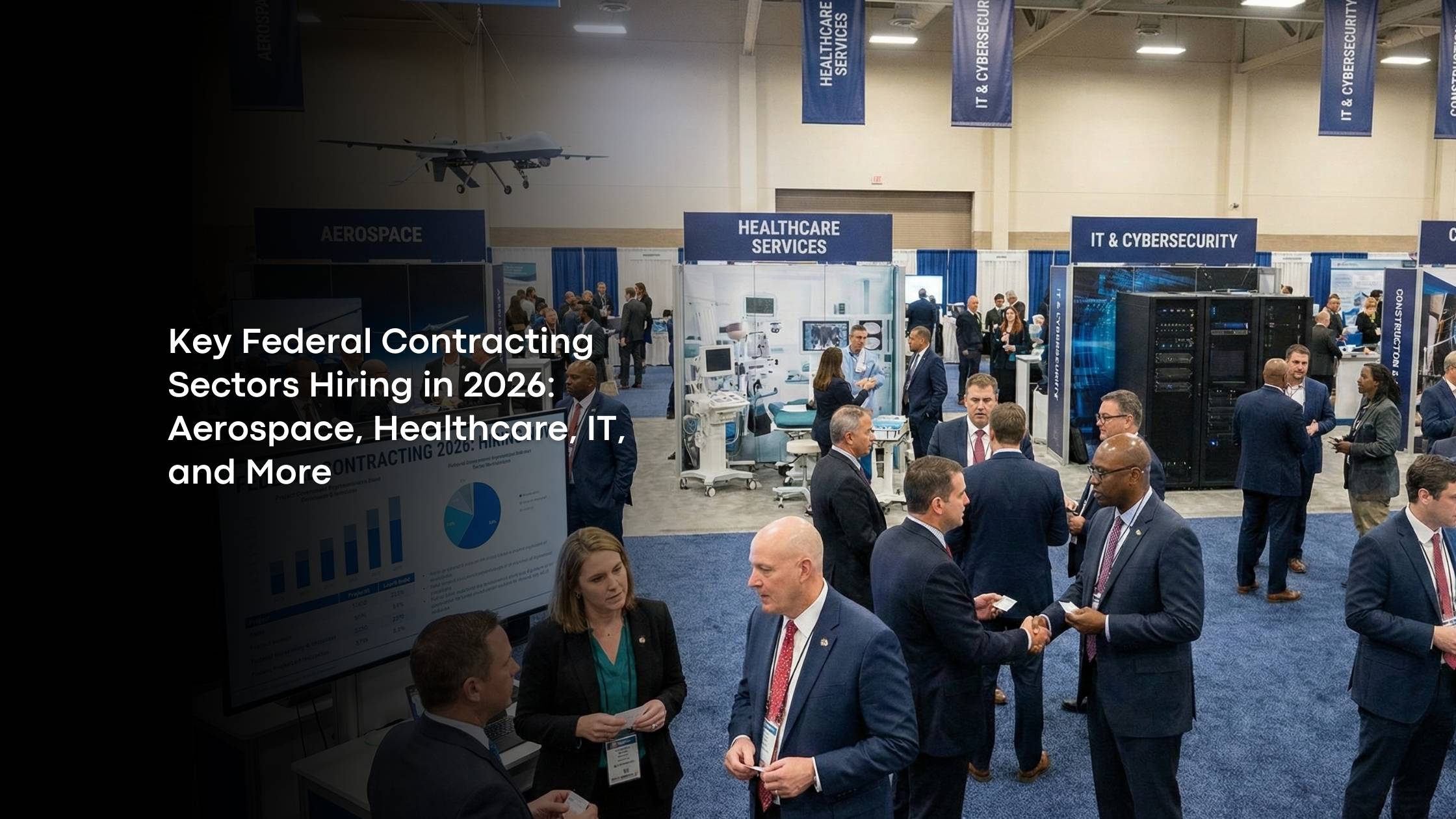
The federal contracting sector will experience its most significant workforce expansion during 2026, which will create employment opportunities across multiple advanced industries. The field of aerospace research and development, along with essential medical services and fast-growing information technology and cybersecurity roles, now offers new job opportunities.
Understanding federal contracting hiring trends is essential because they help job hunters and companies meet the demands of modernization, national security, and digital transformation. Let us dive into the blog to know more about the key federal contracting sectors hiring in 2026 in Aerospace, healthcare, IT and more.
Aerospace and Defense
Federal contracting relies on the aerospace and defense sectors as essential components. The military services will keep hiring new personnel because they plan to spend money on aircraft modernization, missile defense, space exploration, and unmanned systems until 2026.
The Department of Defense and Space Force contractors currently need to hire engineers, systems analysts, avionics specialists and experts staffing in aerospace & IT. The global security situation leads to permanent job openings in this sector that provide employees with excellent career development opportunities.
Healthcare and Life Sciences
The federal government expands its healthcare contracting activities for three main reasons. The Department of Health and Human Services (HHS), NIH, and VA agencies have started to outsource their healthcare IT, clinical research, data analytics and telemedicine services.
The healthcare system needs professionals who can work at the crossroads of medicine and technology, according to the growing GovCon sector demand.
Information Technology and Cybersecurity
The federal contracting sector is experiencing rapid growth driven by information technology. The industry needs software developers, network architects, and cybersecurity analysts as organisations adopt cloud migration, zero-trust security frameworks, and artificial intelligence, along with data modernization programs.
Federal agencies require secure digital services therefore, they are expanding their workforces to complete upcoming projects.
Artificial Intelligence and Data Analytics
Federal contracting hiring trends use artificial intelligence for operational purposes, as it has become a standard technology. In 2026, agencies will increase their use of artificial intelligence to develop predictive analytics, fraud detection, defense intelligence and citizen services.
Government contractors are actively hiring data scientists, machine learning engineers and AI ethics experts. The government contracting industry is experiencing increased demand as organizations adopt artificial intelligence technology, especially for their technology contracts.
Infrastructure and Construction
The federal infrastructure investment program creates more employment opportunities for construction workers, engineering professionals, and project managers. The construction of transportation systems and energy facilities, as well as the renovation of federal buildings, generates constant demand for skilled workers.
The construction industry needs civil engineers, environmental consultants and construction supervisors as its most important workforce. The construction market offers contractors who specialize in sustainable building practices and federal safety compliance special advantages.
Logistics and Supply Chain Management
Federal agencies require reliable logistics networks because their defense operations, disaster response efforts and healthcare delivery requirements depend on those networks. Contractors who provide procurement services, transportation services and inventory management services are expanding their workforce because global supply chains continue to be complex.
The organization needs to hire logistics coordinators, supply chain analysts, procurement specialists and warehouse operations managers. The organization needs these roles to ensure mission success across all federal operations in the United States and abroad.
Education and Workforce Development
The government provides educational contracts to support workforce development, online learning systems and academic research projects. The programs work to improve national talent development systems in STEM fields and in healthcare and vocational training.
The hiring process needs to focus on four main positions, including instructional designers, education consultants, curriculum developers and program coordinators. The federal government funds reskilling and upskilling programs that create ongoing employment needs in this industry.
Energy and Environmental Services
The federal sustainability objectives shape hiring patterns across three sectors, including renewable energy, environmental compliance, and climate resilience programs. The agencies make financial commitments to clean energy initiatives, emissions tracking and environmental restoration projects.
Organizations now require environmental engineers, energy analysts, sustainability consultants and professionals who ensure regulatory compliance. The federal climate programs require contractors to maintain steady workforce growth until 2026.
Professional Services and Consulting
The employment growth rate for professional services firms that provide support to federal agencies continues to increase. The government requires management consulting, financial advisory, compliance auditing, and program management services for its major initiatives.
Agencies require program managers, policy analysts, risk consultants, and financial analysts to support budget optimization, project management, and performance evaluation. These positions serve as effective entry points for individuals seeking to establish career paths in federal contracting.
Staffing Trends and Career Outlook in the Federal Contracting Sector in 2026
- Federal agencies require more specialized workers which results in an increased demand for government contractor jobs 2026 for IT, cybersecurity, and data analytics professionals.
- The practice of skill-based hiring has increased because employers now prefer to hire candidates who have certifications and practical experience instead of following traditional degree requirements.
- Diversity, equity, and inclusion initiatives now drive organizations to create new recruiting methods that help them recruit candidates from various demographic groups.
- Organizations now offer better contracts, with improved salaries and benefits for contract positions, helping them attract skilled employees who currently work in other industries.
- The government contracting field provides strong career mobility because employees have established routes to advance from junior positions to senior roles.
- The ongoing federal spending on defense, health, and infrastructure projects will lead to permanent employment growth in government contractor positions through 2026 and beyond.
Bottom Line
The federal contracting hiring trends of 2026 will create valuable business opportunities for contractors who can establish operations in aerospace, healthcare, IT and emerging technological fields. Businesses now require real-time compliance and competitive market knowledge to sustain their operations.
The GovCon Associates LLC provides businesses with professional knowledge, specific resources, and tactical support, enabling them to secure appropriate contracts at an accelerated pace. The federal marketplace offers you a valuable opportunity to expand your business operations. Your business will achieve federal contracting success by partnering with GovCon.