

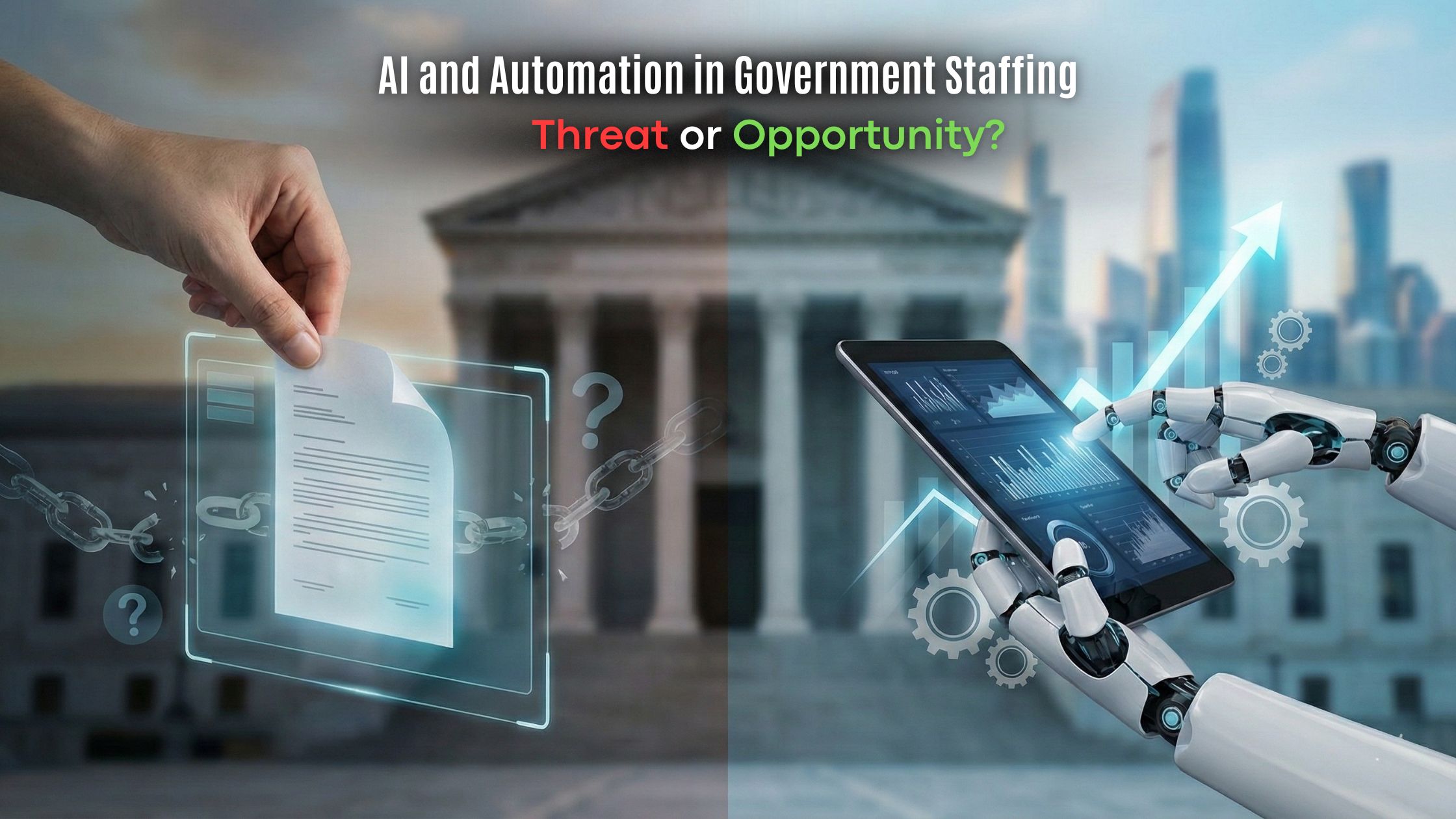
Now, AI is everywhere and government organizations are no exception. In order to thrive in the industries today, people should consider learning about AI and its advancements. The term AI in government staffing is all about the application of AI in governmental operations. It is also applicable to the laws and regulations that authorities create to govern the use of AI by individuals and private businesses.
Like other cutting-edge technologies, automation and artificial intelligence (AI) pose serious threats alongside their ability to enhance people’s lives everywhere. Read on to understand whether AI and automation in government staffing are a threat or an opportunity.
Global nations using AI
According to the Organization for Economic Co-operation and Development (OECD), there are more than 1,000 AI policy ideas from 69 nations, territories, and the EU, including around 800 governance projects.
Even though every nation has its own AI policy, there are risks associated with AI development that could affect any nation. As a result, leaders meet to debate these issues and exchange resources through several international collaborations.
For instance, in 2023, the UN organized an AI advisory council that included representatives from the public and corporate sectors, as well as academics. It also hosts the AI for Good Summit every year. A task group on AI is also part of the World Economic Forum. The following leading nations are pursuing AI
- United States
- China
- European Union
- India
- Japan
- Brazil
United States
The US government has contributed both funding and resources to advance in the field of artificial intelligence.
US President Joe Biden issued an executive order (EO) in 2023 that asked federal agencies to help develop standards, best practices, and recommendations for AI security and safety. At the end of November, based on this EO, the White House Office of Management and Budget announced that the first government-wide policy to use AI and mitigate the risks was still underway.
The US government’s target was to create a public sector innovation with AI that makes the country grow further on a global level.
AI and Automation's Advantages For Government Contracts
Here are some of the advantages of adopting AI and Automation.
Time Savings For More Influence
There is no doubt that time plays an important role in government contracts. The use of AI now saves a lot of time as it can take care of the automated tasks, such as
- Reporting
- Document management
- Compliance tracking
Instead of focusing on these tasks, teams now have enough time to plan the best for the future to reach the goal and beyond. This change will increase workforce efficiency and reduce burnout.
Budget Optimization And Cost Efficiency
AI and automation focus on managing risks to improve operational efficiency. These technologies improve visibility and control across programs.
In fixed-price contracts, uncertainty will raise prices. This transparency will reduce the risk and lead to predictable spending. Government and business may move more confidently toward performance-based models that deliver value while staying within budget as AI reduces unpredictability and human error.
Data-driven Insights For More Intelligent Choices
AI enables the analysis of large, complex datasets to spot trends, identify opportunities, and anticipate challenges. These data-driven insights allow government organizations to predict demand and allocate resources optimally. And improve service delivery with accuracy and assurance.
Knowing the Different AI Types Used in Government
Machine Learning
Government teams use machine learning to analyze data and make choices more quickly. It can filter job applications, highlight qualified applicants, and minimize human error. It increases employee efficiency and saves time. It also supports AI-driven hiring, resume scanning, and the identification of the best job role matches.
Computer Vision
Neural networks are used in computer vision to read images and videos. It is used by governments to identify suspects in criminal investigations or to examine traffic patterns. It handles large amounts of visual data that humans cannot process quickly. Staff obtain better insights without additional work.
Generative AI
In government agencies, generative AI is expanding quickly. Employees can use it to locate information, make drafts, and provide more accurate answers to public inquiries. Several communities will use virtual assistants to assist employees and residents. Chatbots that interact with the public handle basic inquiries so staff members can concentrate on critical issues. This will create digital staffing solutions without replacing human workers.
Intelligent Automation
The use of automation technologies like robotic process automation (RPA) and business process management (BPM) to enhance government decision-making and actions is known as intelligent automation. For example, intelligent automation can be used by governments to handle grant or citizenship applications. Finding applicants with the appropriate abilities listed on their resumes can also speed up the hiring process. It accelerates hiring workflows, increasing automation in HR.
Natural Language Processing
Natural language processing (NLP) is a technique that teaches computers to comprehend and interact with human language. It is a fundamental element of generative AI that enables chatbots and virtual assistants to understand and respond to immediate orders.
Government representatives can use Natural Language Processing (NLP) to analyze data, including aid requests, and identify the most urgent problems. Additionally, it can assist government organizations in searching social media and other online forums to learn about the issues that their citizens are facing.
Optical character recognition
A technique called optical character recognition (OCR) transforms text images into a format that machines can read. To construct searchable databases and redundant backups in case a document is lost or destroyed, the Library of Congress uses this technology to digitize its content. Other government organizations also use it to digitize their old records.
So, is AI a Threat Or an Opportunity?
Many are concerned that AI may eliminate government roles. However, the actual situation is different. It actually helps staff reduce their repetitive tasks and better focus on what matters most to achieve the desired goal. All that matters is updating yourself with technologies so that the future of government jobs is tailor-made for you.
The Bottom Line
Automation and AI won’t replace government workers. AI solutions like federal recruitment technology are here to help them. Government teams can operate more intelligently, quickly, and precisely with tools such as machine learning, computer vision, generative AI, NLP, and OCR. AI and humans will work side by side in government staffing in the future.