

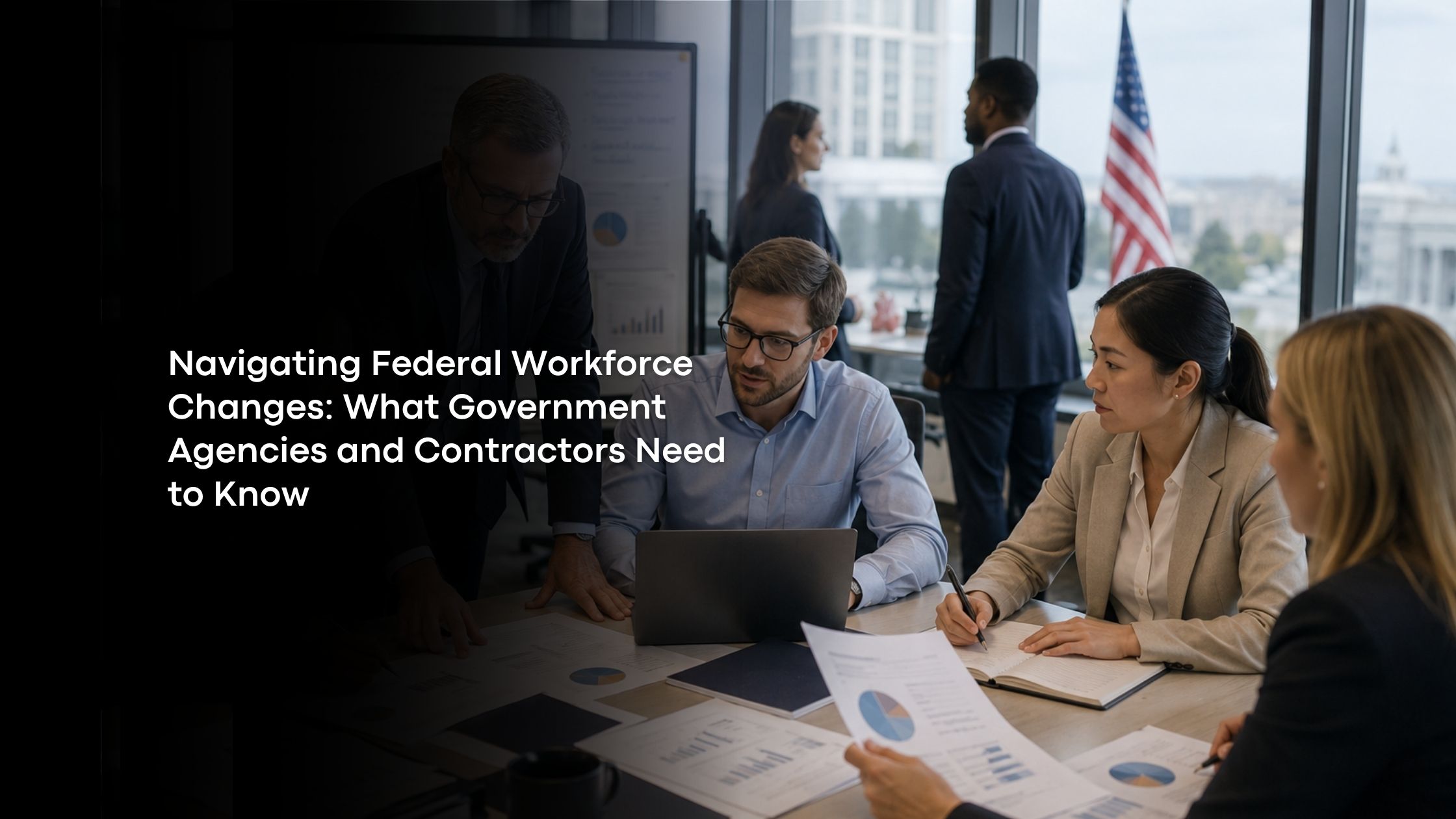
Federal workforce improves under the new country administration and is resetting how agencies staff missions and how contractors set up their teams, price plans, and compliance programs.
Government agencies and vendors that can figure out these shifts and adapt correctly will be best positioned to protect existing work and compete for future opportunities.
Modern Federal Workforce strategies are focused on upskilling and technology adoption. This matters for keeping pace with evolving cyber security along with digital service demands. Read below to understand more about navigating latest federal workforce changes.
The New Federal Workforce Landscape
Workforce Planning is really a must for agencies. It helps teams inside agencies that need to align staffing with budgeting and contracting initiatives with long-term mission goals.
From the start of 2025, the federal workforce has seen something serious. It hit one of the largest ever seen reductions in the current decades. This is the result of a combo of hiring freezes and early retirement plans. Layoff programs also matter.
Optimized Federal Staffing models use full-time employees and term appointments. Also important are contract support. They help with continuity without wasting valuable budgets.
Though, changes in the workforce have not occurred evenly across agencies, and differences are likely related to changing mission priorities. At the same time, the Veterans Affairs department has continued to expand for a long time.
This happens since FY 2015, the Treasury, Agriculture, Social Security Administration, and Health and Human Services have all shown significant workforce reductions.
Strategic Workforce Planning supports teams identifying which roles should remain in-house. It helps find which functions are easily supported by specialized external partners.
Such unevenness should be noticed as it really helps contractors and agencies. It easily displays them about internal capability reduction and scenarios where increased reliance on outsourcing is needed.
Effective Federal Workforce management will need data-supported plans about recruitment, retention, and utilization of contractors.
Key Drivers of Workforce Reshaping
Various policy levers control these types of shifts. So, agencies and contractors should track them closely. Among the most significant:
- Government Contractors play a major role in guiding agency capabilities. It especially helps when internal teams have to take headcount reductions or skills shortages.
- Hiring freezes and targeted reductions in force have limited backfilling of vacancies. It can also start accelerating attrition and push agencies to think which roles actually need full‑time civil staff.
- Early retirement incentives and the DRP helped employees to quit by specific dates while being present on paid administrative leave. This creates expectable but steep drops in headcount.
- Government Workforce policies are increasingly focused on accountability and performance while still trying to attract top talent in critical fields.
- New rules around workforce “accountability” and probationary status have made it easier for agencies to separate employees during their initial period of service, changing risk profiles for new hires and HR planning.
- For contractors, these mechanisms translate directly into changing demand for external support, especially in IT, program management, and specialized consulting where internal expertise may be hardest to replace.
Federal Hiring practices are shifting toward more targeted recruitment for specialized roles in IT, data analytics, and emerging technologies.
Former federal CIO Suzette Kent has argued that this moment is an “inflection point,” where agencies must invest in strategic workforce development, particularly in IT and digital services, instead of defaulting to increasingly expensive long‑term contractor reliance.
The Federal Workforce is undergoing rapid transformation as agencies balance budget pressures with the need to maintain mission-critical capabilities.
What’s Changing for Government Contractors
For contractors, workforce changes inside agencies are intersecting with new contracting rules, executive orders, and compliance expectations. This environment creates both risk and opportunity.
Streamlined Federal Hiring processes help agencies close skills gaps faster and respond more effectively to urgent workforce needs.
Recent years have seen significant adjustments to federal contracting rules that impact how businesses manage their own workforce policies, pricing strategies, and risk management.
A key development is Executive Order 14173, signed in January 2025, which rewrote longstanding affirmative action and diversity, equity, and inclusion (DEI) requirements for federal contractors.
The Government Workforce must adapt to changing mission priorities, from public health and benefits administration to digital transformation and national security.
Under EO 14173, contractors must now certify that they do not maintain any DEI or affirmative action programs, with that certification treated as “material” to payment eligibility.
The order also revokes Executive Order 11246 and related affirmative action requirements and declares DEI initiatives inconsistent with federal anti‑discrimination laws for purposes of federal contracting.
This dramatically alters compliance baselines for many vendors, particularly those whose HR and culture strategies previously centered DEI programming.
A resilient Federal Workforce depends on thoughtful collaboration between internal civil servants and external experts who support specialized functions.
Compliance Obligations That Still Apply
Despite EO 14173’s rollback of certain DEI‑related mandates, not all affirmative action or nondiscrimination obligations have disappeared. Contractors shall try to find which statutes stay completely in force:
- The VEVRAA continues to prohibit discrimination against protected veterans and requires affirmative action in recruiting, hiring, promotion, and retention.
- As regulations evolve, Government Contractors must constantly refine their compliance programs and workforce strategies to remain competitive and eligible for awards.
- Section 503 of the Rehabilitation Act still prohibits discrimination against individuals with disabilities and requires proactive measures to attract and retain these workers.
- Covered contractors must maintain self‑identification processes, outreach programs, utilization goals, job listing requirements, and required taglines for these protected groups, even as they revise or eliminate broader DEI initiatives.
- Federal Staffing will have to consider a complex mix of cost controls and risk management. There is also the need to protect and transfer the valuable institutional knowledge. This creates a nuanced compliance landscape where some forms of affirmative action are mandatory while others are now disallowed in federal contracting contexts.
Policy reforms and executive actions are reshaping the Federal Workforce, impacting how roles are classified, evaluated, and funded across agencies.
Final Thoughts
Workforce transitions will also be an area where agencies will require support. So, contractors need to develop offerings that include change management training, knowledge transfer, etc., together with core technical services.
It is very important for both government agencies and private vendors to understand how the workforce changes at the federal level. They should know how it will impact contracting rules, budgets, and modernization priorities.
For expert guides on working with complex federal workforce and contracting changes, partner with GovCon LLC. We help you align your staffing and compliance initiatives with updated regulations.
Build your agency or contracting firm with GovCon LLC’s individualized support services. Our services are created to optimize workforce planning and proposal development with long-term contract success.