

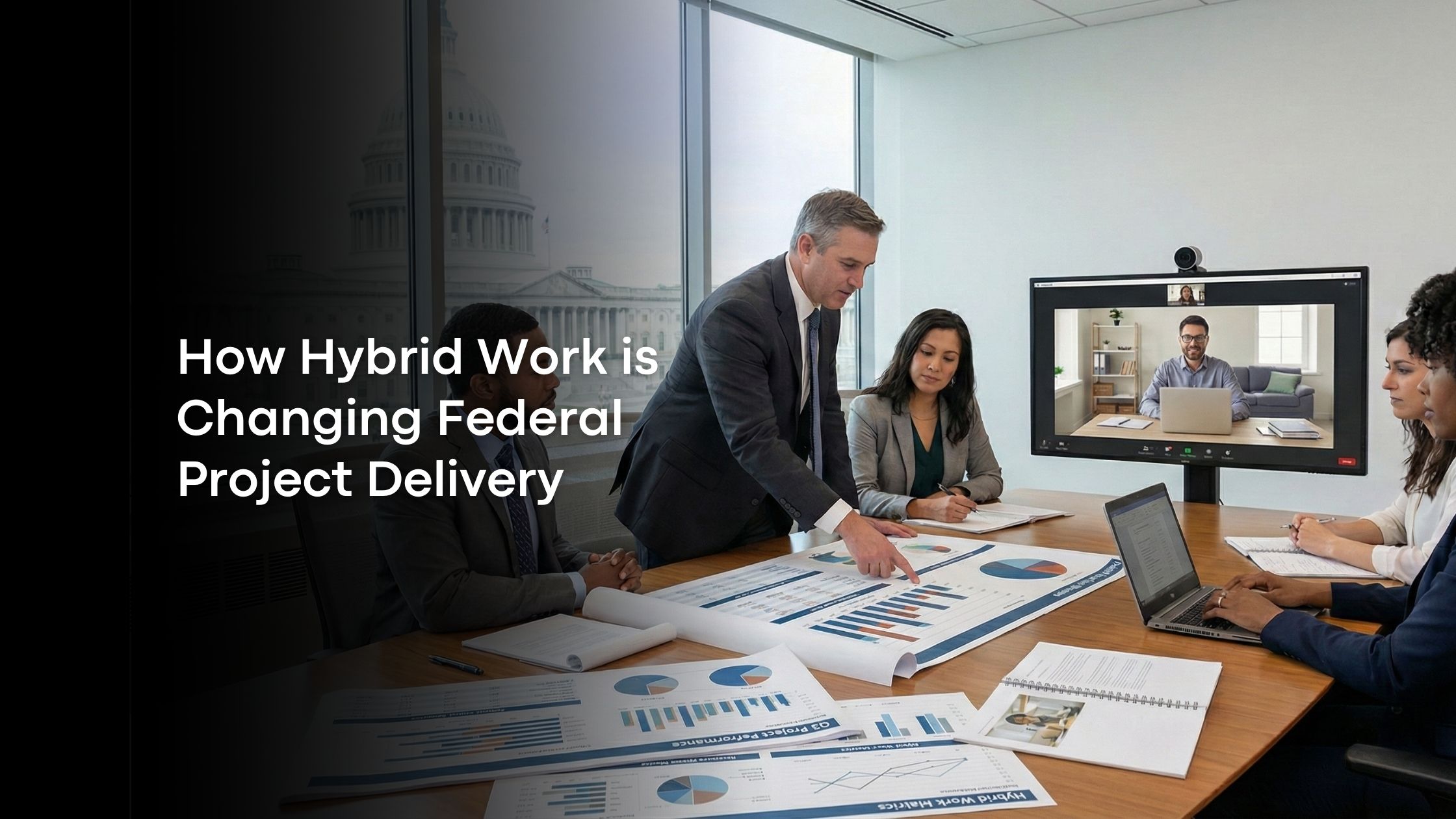
Millions of companies have been investigating the potential of hybrid work arrangements since the 2020 pandemic. Both employers and employees can gain greatly from the hybrid work model as it combines remote and in-office work.
Remote work boosts productivity and schedule flexibility while lowering stress and requiring fewer resources. On the days when employees are in the office, you still experience meaningful direct interactions. Read on to learn how hybrid work is changing federal project delivery and how both employees and employers are making the best out of this change.
The Definition of Hybrid Work in the Federal System
Federal employees who work in a hybrid paradigm alternate between working from home and an agency location. For agencies that wish to customize their remote-work policies, the Office of Personnel Management (OPM) even offers hybrid options. This is a purposeful approach to assist agencies in adjusting how they use
- Physical space
- Distribute work
- Manage projects efficiently.
It goes beyond simply allowing people to work from home.
Traditional Methods
The Waterfall Approach
In federal project management, the waterfall approach has long been a favorite. It is a linear, step-by-step procedure in which each stage must be completed before moving on to the next. In stable situations with infrequent changes to project needs, this model performs well.
For major government programs, Waterfall produces a clear roadmap because it places a high value on the following
Upfront planning
- Documentation
- Tight task ownership.
The final product will be delivered only when every phase of the project is complete. Although the structure is useful, if policies change or new requirements emerge throughout the project, it will be challenging to modify due to its rigidity.
Agencies are discovering that Waterfall is unable to handle the rapid pace, unpredictability, and complexity of contemporary missions as federal work changes. Hybrid project approaches provide a more adaptable option in this situation.
Using Hybrid Work to Complete Federal Projects
Hybrid work combines aspects of office-based and remote collaboration. It combines the freedom of iterative processes with the structure of conventional planning when combined with project management.
Hybrid work is a powerful tool for contemporary delivery, as federal agencies can adjust their strategies based on a project’s complexity, urgency, and risk. This makes hybrid work a strong tool for modern project delivery and supports broader effects in federal digital transformation.
Advantages of Hybrid Work for the Completion of Federal Projects
There are a lot of advantages when it comes to hybrid work for the completion of federal projects. Here, you will learn some of the advantages of hybrid work for the completion of federal projects.
Benefits for Employees
Federal personnel can benefit from both environments through hybrid work. They are better at working together in the office and can concentrate intently at home. This flexibility helps employees stay more engaged by reducing commute time, reducing stress, and improving work-life balance.
When choosing a proper workplace, there is ample room to increase productivity. Employees can visit the office for meetings or networking. Even when a deep conversation is required, office space will be helpful.
Benefits for Federal Organizations
As some jobs require concentration and others require coordination, federal agencies frequently suffer when work is done in a single location. This reduces output and hinders talent recruitment. People can choose where they want to work. Understand that collaboration will take place in the workplace and the focus has to be at its peak while working at home. This will align well with federal workforce trends and support the shift toward smarter, more digital operations.
Implementation Tips For Hybrid Project Managements
For hybrid delivery, the project management should be a successful episode. When it comes to the federal workforce, it isn’t very easy. There will be many stakeholders and expectations involved. Here are some tips for implementing hybrid project management.
Identify the Project’s Needs
Start by thoroughly evaluating your project’s requirements and uncertainties. There will be times when it is necessary in a rapidly changing technical environment, or when policy landscapes demand flexibility and agility. On the other hand, traditional approaches can be needed.
Initiatives for cybersecurity and infrastructure development are two federal projects that often blend aspects of both. A hybrid method will be beneficial when a project requires a degree of both predictability and flexibility. This is where hybrid project teams work best, blending both flexibility and predictability.
Train Your Team
Your team must have a clear grasp of traditional and agile methods. Given the extensive backgrounds and skill sets of government employees, there should be training sessions or seminars on agile methodologies to keep your team up to date. Training also aligns with broader goals in government IT modernization.
Interact with the Stakeholders
Please make sure these stakeholders are aware of the benefits of your hybrid approach and how they fit into the process. When it comes to federal places, you can consider the following officials as the stakeholders.
- Public employees
- Political officials
- General public
Interaction with the stakeholders should be clear. This is so important for telework policy, where expectations must be communicated clearly.
Regularly Review and Adjust Your Approach
One of the main benefits of the hybrid approach is its flexibility. Implementing this flexibility requires a commitment to continuous learning and improvement.
Set up frequent checkpoints to evaluate the project’s progress, gather feedback from stakeholders and your team, and adjust your plan as needed.
For example, you could adjust your tactics in response to new laws, technological advancements, or public sentiment.
Pilot the Hybrid Method
In large-scale federal projects, it may be beneficial to start with a smaller scale or a single part of the project to test the hybrid approach. This enables the team to adapt to the hybrid process, identify challenges, and refine its application before scaling up. Once successful, the hybrid method can be scaled across departments, especially in remote workforce management.
The Final Words
Federal projects are being completed in new ways due to the hybrid work model. With the increasing prevalence of hybrid work in government, teams can better adapt to the evolving market needs. What matters most is making your team have a clear grasp of the advanced technology. Make sure everyone involved in the business understands the importance of the hybrid work model.