

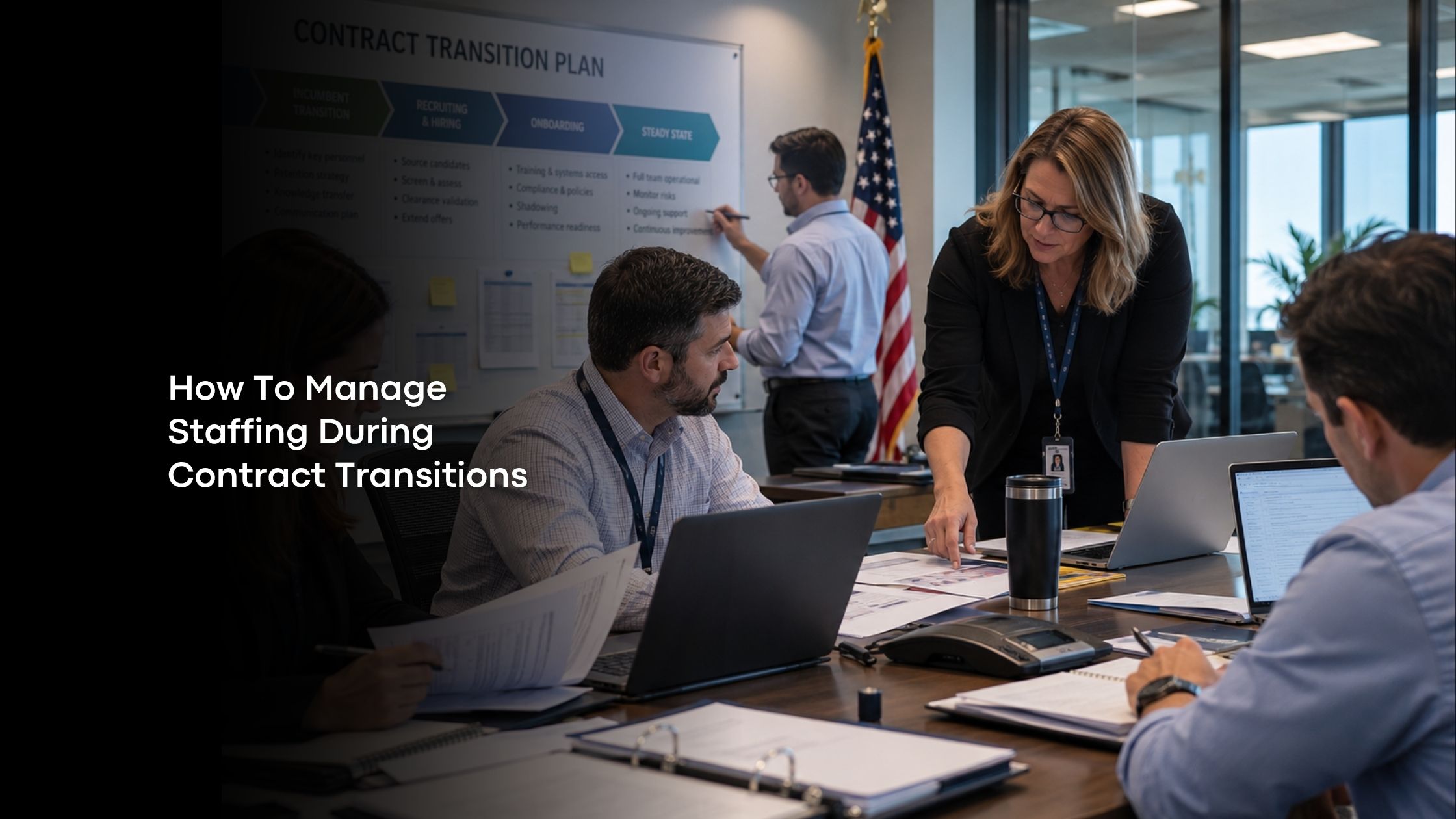
Contract transitions have the potential to bring about a lot of alterations in the workforce of a government contractor within a relatively short time period. The departure of employees, the hiring of new staff members, and maintaining crucial positions filled at the same time that the new team gets ready to take over are some of the issues to be addressed.
Proper government contract transition staffing will enable an organization to cope with the above-mentioned changes without leaving any gaps in contract execution.
Start Staffing Planning Before The Contract Begins
Waiting for the contract award date to plan staffing can cause unwanted stress. An effective contract transition strategy takes into account the needs of the workforce in advance, allowing the contractor to assess the needs of the workforce, clearances, location, and responsibilities.
Review the contract to understand all the positions required, their qualifications, certifications, and security requirements. This will help in establishing the personnel that need to be retained, recruited, and trained.
Plan to do the following:
- Read the staffing clauses: Find out the labor classifications, clearances, and certifications.
- Identify the key positions: This will help you identify the positions that are crucial for performing without a hitch.
- Identify the availability of the workforce: You can match the necessary positions to the available workforce.
Build A Strong Government Contract Transition Staffing Plan
An effective government contract transition staffing plan will combine incumbent retention and external recruitment, processes, systems, and contract details.
Upon assuming the management of the existing contracts, contractors will have to deal with incumbent employees within the context of relevant procurement and contract rules. The employment offer will have to be conditional upon the commencement of the contract, customer approval, or clearance confirmation.
Staffing considerations:
- Identify the key incumbent personnel knowledgeable in operational matters.
- Sustain recruiting channels for positions that will be vacant.
- Compare salary expectations and workforce requirements.
- Conduct checks on employee readiness to meet location requirements.
- Lay out plans to address possible turnover situations.
Manage Security Clearance Requirements Early
Security clearance has the potential to impact workforce readiness on federal contracts. An adequately trained individual could still need some administrative actions performed prior to carrying out certain functions.
The facility security officer should consult with relevant government organizations regarding the process for obtaining clearance, the timeline, and should presume that all clearances would be transferred automatically.
Clearance planning should include :
- Clarification of the clearance needed for each position.
- Evaluation of the clearance status of all relevant personnel.
- Identification of positions that might encounter problems related to clearance.
- Phased onboarding plans as appropriate.
- Communication among security personnel, program managers, and customer representatives.
Protect Critical Roles During Workforce Transition
Workforce transition involves potential risks as experienced employees depart while new hires come on board. The departure of personnel from critical positions can pose operational risks and have implications for the performance of the contract.
The contractor must recognize critical positions and develop a government contract transition staffing approach to protect them early. Succession plans, selective recruitment, and other means of resource allocation may be considered as appropriate.
Critical position protection can involve:
- Recognition of personnel who, upon departure, may have a negative impact on operations.
- Determination of backups for critical positions.
- Side allocation of resources for emergency hiring.
- Assessment of changes in staffing during the early performance period.
- Evaluation of replacement timeframes prior to vacancy becoming a risk.
Make Knowledge Transfer Part Of The Staffing Process
The task of staffing will be made easier by planning the transfer of knowledge. New personnel need to understand the workflow process, systems, procedures, duties, and customer expectations.
Documentation should include critical processes, standard operating procedures, system access needs, and specialized knowledge that may be required. Shadowing could be useful for the new members to learn from the experienced people.
Communication among the government customers, the existing team, and the incoming contractor would help in finding gaps beforehand. It will minimize the risk of losing valuable knowledge through the departure of some personnel.
Use Technology For Routine Recruitment Tasks
Recruitment technology could assist contractors with the organization of data about candidates and administration. An applicant tracking system would be able to give visibility to the applications, progress of candidates, communications, and the hiring process.
Digital scheduling can streamline the interview process, as well as facilitate automated communication to update applicants. The technology should be utilized in a manner that will allow maintaining a practical process that will not distract recruiters from people and contract needs.
Incorporate Compliance Into Employee Onboarding
Government contracting staffing does not stop when the employees begin their jobs. The new employees will have to be educated on compliance, procedures, billing, timekeeping, and security.
Contracts under regulations such as the Service Contract Act will have to take labor classifications, wage requirements, and other benefits into account.
Onboarding should include the following:
- Contract Responsibilities: Knowing one’s particular duties based on the contract.
- Timekeeping and Billing: Understanding how to complete the timekeeping and billing properly.
- Federal Compliance: Having completed the mandatory federal compliance training.
- Security Responsibilities: Following the security and access requirements
- Labor and Wage Requirements: Being knowledgeable about the labor and wage requirements.
Track Staffing Risks Throughout The Transition
A transition plan should be maintained for the entire period of the initial performance. Some potential candidates may pull out, clearances may take longer than anticipated, or current employees may opt not to pursue the opportunity.
A good staffing strategy should contain periodic workforce reviews. It will be possible for leaders to review filled posts, pending needs, the clearance process, the onboarding process, and the need for replacements by means of a transition dashboard.
Areas that should be tracked
- Posts filled and posts left unfilled.
- Critical posts that require urgent attention.
- Processing of the clearance process.
- Onboarding process of potential candidates.
- Status of retention of incumbents.
- Backup candidates for high-risk positions.
Final Thoughts
A stable workforce is critical to a smooth transition of services as stipulated by a contract and to assure customer confidence. The government contract transition staffing process can be simplified by planning ahead, safeguarding key positions and clearances, facilitating knowledge transfer, and addressing staffing risks.
For organizations working in the GovCon environment, having a systematic workforce transition is an important component of a smooth roll-out of services. Thus, companies should work with the experts at GovCon Associates to create a reliable approach to such a transition.
Partnering with this company helps in overcoming numerous workforce challenges associated with contract transitions. Therefore, it is time to contact this specialized group and plan your government contract staffing transition more strategically.